
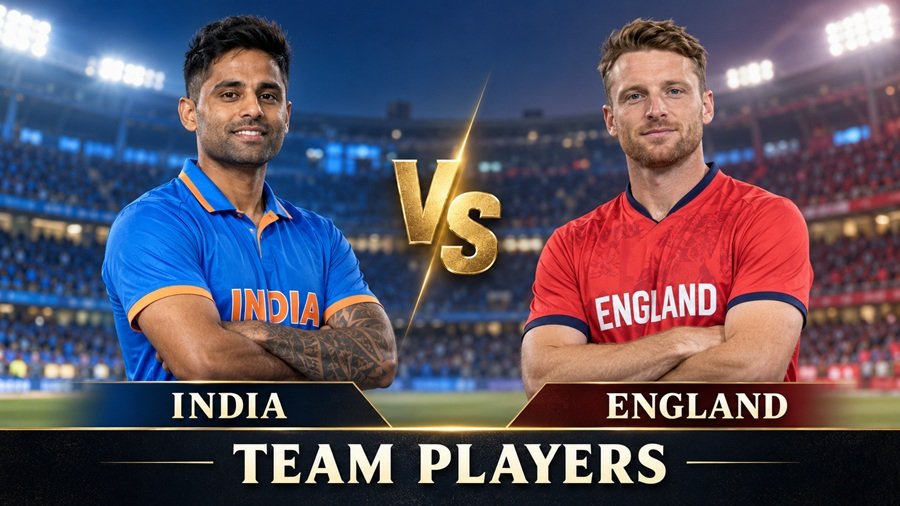
India National Cricket Team vs England Cricket Team players
The comparison of India National Cricket Team vs. England Cricket Team players brings together batters versatile all‑rounders and bowlers who can turn a match in a single over. To understand these players look beyond their names. See the roles they play for their teams.
This article focuses on the playing XIs from the 2026 ICC Men’s T20 World Cup semi‑final played on 5 March 2026 at Wankhede Stadium, Mumbai. India national cricket team won the match by seven runs after both India national cricket team and England cricket team produced batting performances.
Match Overview: India vs England in 2026
The semi‑final offered a comparison of how India national cricket team and England cricket team build their T20 teams. Both India national cricket team and England cricket team selected a mix of specialist batters, wicket‑keepers, all‑rounders and frontline bowlers.
| Match Detail | Information |
|---|---|
| Tournament | ICC Men’s T20 World Cup 2026 |
| Match | Second semi-final |
| Date | 5 March 2026 |
| Venue | Wankhede Stadium, Mumbai |
| India captain | Suryakumar Yadav |
| England captain | Harry Brook |
| Toss | England won and chose to field |
| India total | 253/7 |
| England total | 246/7 |
| Result | India won by seven runs |
| Player of the Match | Sanju Samson |
Sanju Samson’s 89 from 42 balls helped India national cricket team set a demanding target. England cricket team remained competitive through Jacob Bethell’s 105 from 48 balls. England cricket team finished short.
India national cricket team’s Playing XI and Player Roles
India national cricket team combined a batting lineup with several bowling options. Suryakumar Yadav captained India national cricket team while Sanju Samson was the designated wicket‑keeper for India national cricket team.
| Player | Role |
|---|---|
| Abhishek Sharma | Batting all‑rounder |
| Sanju Samson | Wicketkeeper‑batter |
| Ishan Kishan | Wicketkeeper‑batter |
| Suryakumar Yadav | Captain and batter |
| Tilak Varma | Batter |
| Hardik Pandya | Batting all‑rounder |
| Shivam Dube | Batting all‑rounder |
| Axar Patel | Bowling all‑rounder |
| Arshdeep Singh | Bowler |
| Varun Chakaravarthy | Bowler |
| Jasprit Bumrah | Bowler |
These were India national cricket team’s confirmed players for this match. Selection can change across series, formats and individual fixtures.
Sanju Samson, Abhishek Sharma and Ishan Kishan
India national cricket team’s top order provided ways to attack the bowling. Sanju Samson and Abhishek Sharma occupied the opening positions with Ishan Kishan adding another batting option for India national cricket team.
Sanju Samson delivered the standout India national cricket team innings in the semi‑final. Ishan Kishan contributed 39 from 18 balls helping maintain the scoring momentum for India national cricket team.
Why the Top Order Matters for India national cricket team
The opening overs shape the rest of a T20 innings for India national cricket team. A strong start allows the middle order to attack without spending much time rebuilding for India national cricket team.
However attacking batting also brings risk for India national cricket team. The effective top orders combine boundary hitting with an awareness of conditions, field placements and the quality of the bowling for India national cricket team.
Suryakumar Yadav and Tilak Varma of India national cricket team
Suryakumar Yadav and Tilak Varma give India national cricket team specialist batting options beyond the opening positions.
Their responsibilities depend on the match situation for India national cricket team. They may need to continue a start recover after early wickets or accelerate towards the end of the innings for India national cricket team.
Hardik Pandya, Shivam Dube and Axar Patel of India national cricket team
All‑rounders make India national cricket team selection more flexible because they contribute in than one discipline for India national cricket team.
Hardik Pandya and Shivam Dube offer batting strength alongside bowling options for India national cricket team. Axar Patel adds a bowling‑focused all‑round role giving Suryakumar Yadav another way to balance India national cricket team.
How All‑Rounders Improve Team Balance for India national cricket team
An additional bowling option becomes useful when a specialist bowler has an expensive over or when a particular matchup favours a change for India national cricket team.
Batting depth also allows the players above them to approach their innings with freedom for India national cricket team.
Jasprit Bumrah and India national cricket team’s Bowling Options
Jasprit Bumrah, Arshdeep Singh and Varun Chakaravarthy formed India national cricket team’s specialist bowling group in this XI.
A balanced attack must handle phases: finding early wickets controlling the middle overs and defending runs at the finish for India national cricket team. Captains also need to decide whether to use their bowlers immediately or save overs for a later threat for India national cricket team.
England cricket team’s Playing XI and Player Roles
England cricket team selected a flexible team, with Harry Brook as captain and Jos Buttler as the designated wicket‑keeper, for England cricket team.
| Player | Role |
|---|---|
| Phil Salt | Wicketkeeper‑batter |
| Jos Buttler | Wicketkeeper‑batter |
| Harry Brook | . Batter |
| Jacob Bethell | Batting all‑rounder |
| Tom Banton | Wicketkeeper‑batter |
| Sam Curran | Bowling all‑rounder |
| Will Jacks | Batting all‑rounder |
| Jamie Overton | Bowling all‑rounder |
| Liam Dawson | Bowling all‑rounder |
| Jofra Archer | Bowler |
| Adil Rashid | Bowler |
These roles describe the types of players. Having several wicketkeeper-batters in a team does not mean players all keep wicket in the match.
Phil Salt and Jos Buttler
Salt and Buttler give England options at the start of the batting line.
For opening batters the challenge is to use the powerplay rules and keep wickets for the rest of the overs. That balance is very important when chasing a target.
Harry Brook and Jacob Bethell
Brook does both. Leading England.
Bethell gave England the innings in this semi‑final. Bethells century kept the chase alive. Showed how one big score can keep a team together when pressure is high.
Building Partnerships During a Chase
A chase needs more than single boundaries. Partnerships keep a batting side moving. Stop a batting side from having to rebuild over and over.
The supporting batter also must rotate the strike pick balls to hit and keep the main player working.
England’s All‑Round Options
Curran, Jacks, Overton and Dawson gave England ways to spread their overs and stretch their batting.
This flexibility lets a captain react to conditions and specific matchups. The worth of an all‑rounder comes from how their skills match the team’s needs on that day.
Jofra Archer and Adil Rashid
Archer and Rashid gave England bowling choices.
Against a batting lineup, bowlers must mix intent to take wickets with control. Fielding positions, changes in pace and the timing of bowling changes can be as important as deliveries.
Comparing the Two Teams
The comparison between the India team and the England team shows team building. Both sides have batting, several all‑rounders and specialist bowlers.
| Area | India | England |
|---|---|---|
| Captain | Suryakumar Yadav | Harry Brook |
| Designated wicketkeeper | Sanju Samson | Jos Buttler |
| Specialist batting options | Suryakumar Yadav, Tilak Varma | Harry Brook |
| Batting all‑round options | Abhishek Sharma, Hardik Pandya Shivam Dube | Jacob Bethell Will Jacks |
| Specialist bowling options | Bumrah Arshdeep, Varun | Archer, Rashid |
The best comparison looks at roles, conditions and team balance not at every player the way. A bowler’s contribution cannot be judged the same as an opening batter’s.
Squad. Playing XI: Understanding the Difference
A squad is the group that can be chosen. The playing XI is the eleven players picked for a match.
India’s bench had Kuldeep Yadav, Mohammed Siraj, Rinku Singh and Washington Sundar. England’s bench had Ben Duckett, Luke Wood, Josh Tongue and Rehan Ahmed. They were not in the confirmed starting XI for this semi‑final.
Players chosen for a T20 match may differ from those chosen for an ODI or Test. Always check the match date and format when looking at India and England team lists.
Frequently Asked Questions
Who captained India against England in the 2026 T20 World Cup semi‑final?
Suryakumar Yadav captained India.
Who was England’s captain?
Harry Brook led England in the match.
Who were the designated wicketkeepers?
Sanju Samson kept wicket for India while Jos Buttler performed the role for England.
Which players produced the leading batting performances?
Samson scored 89 from 42 balls for India. Bethell scored 105 from 48 balls for England.
Are these players selected for every India vs England match?
No. These are the confirmed players for the 5 March 2026 semi‑final. Teams can change between matches and formats.
Conclusion
The India National Cricket Team vs England Cricket Team players comparison shows the batting strength, bowling options and all-round abilities of both sides.
In the 2026 T20 World Cup semi-final, Sanju Samson led India’s batting effort while Jacob Bethell’s century kept England in the chase. India secured a seven-run victory. Knowing each player’s role and looking at the playing XI helps readers compare the teams more clearly.